As A Potential Solution To The Cement Industry’s Decarbonization Challenge, Can Hydrogen Overcome Technical And Economic Hurdles To Become A Practical Fuel For Cement Kilns?
By Jonathan Rowland
Hydrogen is the “perfect low-carbon fuel, as it has no carbon at all,” independent consultant John Kline told Cement Optimized. Recent trials, such as at Holcim’s La Malle cement plant in France, also offer encouraging evidence. Working with combustion specialist Fives Pillard, the plant successfully achieved hydrogen substitution rates exceeding 50% of the total fuel mix without affecting clinker quality.
The La Malle trials also showed that, beyond the 50% substitution threshold, hydrogen’s higher flame temperature enabled greater use of renewable biomass fuels, creating a double decarbonization effect.
This effect has also been observed in research by Dr. Tahir Abbas and his team at Cinar, who, in plant trials, noted that cofiring lower-calorific-value (CV) biomass with hydrogen produced a kiln flame similar to that under 100% coal-firing conditions, enabling much higher substitution rates (up to 70% biomass with 30% hydrogen) than with coal-biomass cofiring, where substitution rates are limited to 20%.
“Hydrogen’s higher reactivity releases heat earlier, prompting the biomass to ignite in the near-burner region and producing a compact, radiating flame, as required for good-quality clinker production,” Abbas said.
What Makes Hydrogen Different?
Hydrogen is the lightest element and burns at significantly higher temperatures than conventional fuels. These characteristics present both opportunities and challenges. As noted during the La Malle trials and by the Cinar research, higher flame temperatures can facilitate the combustion of lower-calorific-value biomass fuels, while accelerating clinker-formation reactions.
However, hydrogen’s thermal radiative heat transfer is less than half that of coal, which poses challenges in the near-burner region, where radiative heat transfer typically accounts for about 95% of the total heat transfer to the charge.
“A hydrogen flame is shorter and hotter,” noted Abbas, who has conducted extensive computational fluid dynamics modeling of hydrogen combustion in cement kilns. Unless hydrogen is co-fired with larger, slower-burning fuel particles, higher hydrogen co-firing conditions may thus shorten the calcination zone, shifting the sintering reactions closer to the burner tip and causing significant damage.
“Flame shaping becomes critical when co-firing hydrogen in the kiln to avoid local overheating,” added Jean-Michel Charmet of Fives FCB. “Hydrogen’s high reactivity can be beneficial in the precalciner but increases sensitivity to air distribution and mixing. Higher water vapor in the gas phase also slightly modifies heat exchange and lowers the decarbonation temperature.”
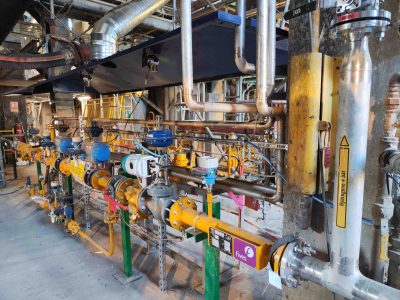
The molecule’s extreme reactivity also presents handling challenges, as John Kline, principal at Kline Consulting LLC, noted. “Hydrogen is a very light gas; it can easily escape from pipeline joints, valves, and instrument locations.” It is also famously flammable (as anyone with even a vague interest in the history of airships will attest). Specialized handling procedures, piping and sealing are thus required, as are additional safety systems, including leak detection, ventilation and purging. The gas must also be kept under pressure.
Process and Equipment Modifications
Integrating hydrogen into existing cement plants requires careful attention to burner design and fuel delivery systems. In research trials conducted by Abbas and colleagues at a UK cement plant, in which hydrogen reached nearly 40% thermal substitution rate, the team modified existing multi-channel kiln burners to introduce hydrogen through specifically designed nozzles in the central port. “By doing so, the higher but localized temperatures are shielded and transmitted to surrounding cofiring fuels,” Abbas explained, indicating that hydrogen injection velocities of at least 275 m/s are required to prevent the flame from being drawn too close to the burner tip.
“Most multichannel kiln burners can be adapted to co-fire hydrogen by installing a higher-velocity nozzle within an existing gas nozzle,” Abbas continued. However, the resulting flame characteristics and co-firing ratios and range must be maintained through detailed mineral-interactive CFD modeling to achieve a stable, low-emission, attached, and compact flame. This is because the co-firing fuels “may not fully burn due to flow stratification caused by an earlier combustion of more reactive fuels, including hydrogen.”
During the La Malle project Fives Pillard also used thermal simulations and CFD to “extrapolate a number of tests to determine the hydrogen-firing conditions that could apply to all cement plants,” noted Loïc Giaconia, research and development engineer at the company.
NOx Formation and Control
Hydrogen’s higher flame temperature also raises concerns about NOx formation. This is a function of three factors, as explained by Kline, whose recent work focused on improving the environmental impact of cement production. These factors are temperature, oxygen level and fuel nitrogen.
“Without specialized burners, the intense flame from hydrogen combustion could produce higher levels of thermal NOx in the kiln. In contrast, the lack of fuel nitrogen could result in lower calciner NOx, assuming that hot spots can be minimized through raw meal mixing and multiple firing points.”
“NOx formation potential is higher when firing hydrogen in the kiln, due to its higher flame adiabatic temperatures,” agreed Abbas. However, modelling and plant trials have shown that, when co-fired with other fuels, including lower-quality alternative solid fuels, the regions of higher gas temperature are reduced, thereby limiting thermal NOx formation and ultimately leading to lower NOx at the kiln feed end than in coal firing. Higher-reactivity hydrogen also consumes most of the burner primary air, thereby limiting the oxygen available to oxidize other fuels; under starved-air conditions, these fuels are reduced to nitrogen.
Clinker Quality Maintenance
Switching to hydrogen could risk clinker quality if not properly managed, according to Charmet, including overheating, shifts in the burning zone profile, and changes in sulfur cycles. The volatile cycle – in which alkali chlorides, sulfates and other compounds evaporate in the burning zone, condense in the preheater, and recirculate – presents a particular concern. Kline noted that hydrogen combustion increases water vapor in the kiln atmosphere, and “water vapor tends to increase volatile evaporation.” This could intensify the volatile cycle, potentially leading to coating and buildup problems in the preheater and kiln inlet.
The concern could be compounded when co-firing hydrogen with biomass-based alternative fuels, which often contain higher chloride levels than conventional fuels. Abbas’s UK research reported volatile-related operational problems during their hydrogen-biomass co-firing tests; however, longer-term industrial experience will likely be needed to fully understand hydrogen’s impact on kiln chemistry and the potential impact on (or need for) bypass systems.
That said – and as the La Malle trials demonstrated – it is possible to co-fire with hydrogen without any detrimental impact on clinker quality. “The use of a hydrogen gas flame, when optimized to consider flame length, thermal radiative heat transfer, co-firing fuels, and burner fuel-air mixing characteristics, will not have any negative effect on clinker quality,” said Abbas, whose own trials demonstrated no impact on clinker quality when co-firing hydrogen up to 40%.
Energy Efficiency Considerations
Hydrogen’s lower radiative heat transfer properties might initially appear problematic for energy efficiency. In conventional coal or petcoke flames, radiative heat transfer dominates the near-burner region, effectively heating the raw meal. In contrast, hydrogen flames retain more heat in the combustion products, potentially leading to higher stack temperatures and reduced thermal efficiency.
Co-firing with solid biomass fuels partially addresses this concern. These solid fuel particles exhibit radiative heat-transfer characteristics like those of conventional fuels, compensating for hydrogen’s deficiency. As Abbas’s work has shown, biomass fuels burn slowly over several kiln diameters, extending the hot zone and maintaining appropriate heat transfer to the charge. Optimizing burner-tip design and momentum ratios also helps mitigate a potential energy-efficiency penalty.
The Economics of Green Hydrogen:
A Path to Viability?
Technical feasibility alone is insufficient to drive widespread adoption of hydrogen in cement production, and the economics remain challenging. Kline noted that producing, liquefying and transporting hydrogen while building the necessary infrastructure “requires a great deal of green electricity, which explains its high cost.” Current green hydrogen costs in Europe and North America far exceed blue hydrogen (produced from natural gas with carbon capture), which in turn costs more than conventional fuels.
Hydrogen transportation costs are also extremely high, Abbas added, as liquid hydrogen requires cryogenic storage. One alternative is to convert hydrogen into ammonia (NH3) for transport, converting it back to hydrogen or firing it as ammonia in the kiln – both cases without carbon emissions. Although there is an energy penalty to doing so, ammonia infrastructure is more readily available. It has a lower CV, is comparable to that of most biofuels and can be co-fired directly in a kiln or calciner, thereby increasing energy efficiency.
The business case improves considerably if plants can access surplus hydrogen from nearby industrial processes at lower costs than market rates. On-site hydrogen production via electrolysis powered by dedicated renewable energy sources offers another potential pathway. This approach could enable cement plants to use oxygen – a by-product of electrolysis – either internally (for oxy-combustion processes) or for export, offsetting some production costs. However, this strategy requires substantial capital investment.
Kline also noted reliability concerns based on current experience: “Many plants have used small electrolyzers to generate small amounts of hydrogen to heat flames and improve combustion of alternative fuels. While the hydrogen burns well, the electrolyzers need very clean, if not deionized water, suffering high maintenance and low reliability when using mineral-rich water.” Future electrolysis must address these issues before becoming practical for cement production.
Verdict: Promising But Not Yet Practical
So, is hydrogen a viable fuel for cement manufacturing? The technical case is increasingly solid. Yet, the economic case remains problematic, and interest in hydrogen in North America has been muted beyond the adoption of hydrogen at Cemex plants in Mexico.
The most promising near-term applications are likely at plants with access to low-cost or surplus hydrogen from adjacent industrial facilities, particularly in regions with abundant renewable energy. For the broader industry, hydrogen could be a component of the decarbonization toolkit, likely to allow higher co-firing of other alternative fuels. Its role might expand as renewable energy becomes cheaper and more abundant, carbon prices increase, and the necessary supply infrastructure develops.
After all, the cement industry’s experience with alternative fuels suggests that today’s expensive novelties can become tomorrow’s standard practice. However, 100% hydrogen-fired cement production lines remain firmly in the future – if they ever become a reality.