Trimble conducted a survey at its 2025 Dimensions user conference in December 2025, and roughly 1,800 industry professionals responded. The results offer a clear roadmap for where the industry is heading and, more importantly, what it will take to succeed in an increasingly digital and labor-constrained market.
Here are some of the key takeaways:
The Human Element: Solving the Labor Shortage
When asked about the biggest challenges facing their companies in 2026, respondents were clear: it’s all about the people. The top concerns cited were workforce skills, hiring and retention, closely followed by the challenge of adopting or optimizing the right technology.
According to industry estimates, the construction sector will need to attract nearly half a million new workers in 2026 alone just to keep pace with demand. This is exacerbated by the fact that nearly a quarter of the current workforce is set to retire within the next decade.
Ian Warner, director of industry workforce development and innovations at Trimble, emphasized that technology is not just a tool for productivity, but a vital recruitment asset. “Technology and training will be key to attracting the next generation workforce,” Warner noted. “Contractors that invest and deploy the latest technology will have a competitive advantage by optimizing employee productivity and being able to do more with less.”
Combining hands-on experience with cutting-edge digital tools will enable companies to upskill their current teams, while also making the industry more attractive to a tech-savvy younger generation.
Breaking Down Silos: The Push for Interoperability
As companies adopt more digital tools, a new problem has emerged: fragmentation. The Dimensions survey revealed that the initiatives with the most potential to improve performance in 2026 are improving how existing technology and data integrate, alongside getting employee buy-in for these tools.
Currently, many construction projects are bogged down by diverse teams using different technology stacks that don’t share data with one another. This “data siloing” leads to errors, delays and lost revenue. The industry is now demanding the ability for data to flow seamlessly between software systems so every stakeholder can access the same information.
Chris Peppler, vice president of platform at Trimble, sees this as a major focus for 2026. “In the year ahead, construction technology vendors, including Trimble, will continue to accelerate efforts to enhance data interoperability, delivering greater value to contractors,” Peppler explained. “This includes building more workflows and integrations between construction technology ecosystems via Trimble Marketplace, a centralized online catalog of over 100 pre-built and verified integrations, applications and extensions that extend Trimble connectivity to leading third-party software.”
Trimble is no stranger to the push for more interoperability, and we will continue to help contractors connect their data because we understand that an open ecosystem equates to more efficient project delivery.
Top Wishlist: AI and Precision
If costs were no object, where would industry leaders put their capital? The Dimensions survey revealed a strong desire to invest in innovation, with the top “wish list” investments for 2026 being:
- AI Adoption: Leveraging artificial intelligence to automate complex workflows and predictive analytics.
- Scanning and Positioning: Investing in advanced surveying and positioning technologies to ensure millimeter-level accuracy on-site.
Aviad Almagor, vice president of technology innovation at Trimble, believes that in 2026, isolated Agentic AI pilots will move beyond experimentation to impact real-world workflows. “Networks of AI agents will operate across design, engineering and construction in connected ecosystems – streamlining design processes, orchestrating schedules, resolving conflicts, tracking progress, managing resources and more,” said Almagor.
To further aid this effort, Trimble recently launched Trimble Agent Studio, an open and extensible agentic AI platform that’s a collection of core services, security frameworks and tools used by Trimble to build and deploy safe, scalable, and secure agentic AI systems. The platform unlocks industry-scale innovation by empowering partners and customers to create and deploy AI agents and multi-agent workflows across Trimble’s suite of construction solutions.
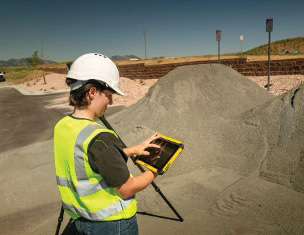
When it comes to scanning and positioning, reality capture technology is already invaluable for precision, safety and speed, but Arnaud Lezennec, senior applications engineer at Trimble, believes it will become even more democratized in 2026. “New user-friendly tools will enable even more comprehensive data collection and accuracy for faster and improved decision-making,” noted Lezennec.
This includes the recent launch of ProjectSight Site Capture, which brings reality capture to project management workflows, enabling contractors to visually track progress, quickly identify issues and collaborate on solutions in real time. Enhanced by AI, machine learning and cloud-based platforms for sharing and collaboration, this rich spatial data not only improves contextual information but also serves as a common visual language for all stakeholders to align efforts across projects and reduce misunderstandings.
The results of the 2025 Trimble Dimensions survey highlight a fundamental truth: technology and talent are both essential to future success. You cannot solve the labor shortage without modernizing the work, and you cannot maximize your technology investment without a skilled, engaged workforce.
Advanced tools will only help if the workforce is trained to use them, and the data they produce can flow freely across the organization. By focusing on innovation, interoperability and talent development, the construction industry can transform its current challenges into its greatest strengths.